The work runs itself. The decisions come to you.
We build AI systems that read, enter, draft and report the routine work in your business, inside the software you already run. Anything that spends money, sends or changes a record waits for a person.
One job live in four to six weeks · built in your accounts · yours to keep
Northgate Supply Co.
Illustration · a sample distributor, 60 people
Tuesday a.m.
Revenue, September
$1,437,600
One definition, agreed by finance and sales
Hours handed back each week
34 hours this week
Orders filled complete
95.1%
Goal 95% · shipped on time 87.8%
Done since 6 a.m.
- Inbox3 late-delivery questions answeredReplied
- OrdersShip dates promised on 11 ordersSent
- InvoicesSame invoice billed twice by one supplierHeld
- CRM34 contacts updated from yesterday’s callsProposed
- Quotes7 quotes drafted from the price bookDrafted
Needs you
Hold $4,230?
Ridgeway Industrial billed the same three lines twice, on INV-20931 and INV-20958, both against PO 7714.
Same job. Six weeks later.
Pick a job your team does every day. Then watch which steps the system takes over, and which stay with a person.
- Hands-on work
- 46 minutes
- People involved
- 3
- Start to finish
- 6 days
The system does itA person decidesIllustrative: a sample distributor. We measure your own steps and times in week one.




One supplier invoice, from the inbox to paid
- Open the supplier’s emailAP clerkSystem2 min + waits 1 dayread on arrival
- Download and rename the PDFAP clerkSystem2 min2 sec
- Key 14 fields into the ERPAP clerkSystem9 min6 sec
- Find the matching purchase orderAP clerkSystem5 min1 sec
- Check quantities against the receiving slipWarehouse leadSystem8 min3 sec
- Email the buyer about a price mismatchAP clerkSystem4 mindrafted and sent
- Chase the buyer for an answerAP clerkSystem3 min + waits 3 dayschased on a schedule
- Approve the mismatchControllerController4 min + waits 1 daywith the evidence attached
- Schedule the paymentAP clerkSystem3 minqueued
- Approve payments over $5,000ControllerController3 min + waits 1 dayone click, batch of 12
- File it with the PO and the receiptAP clerkSystem3 minfiled
Most companies have AI. Few have it in the work.
The gap is the difference between a person with a chatbot and a company with a system built into its work. The companies on the right side of it do three things:
They redesign the work
About three in four of the companies getting real returns rebuilt the workflow around AI. Among everyone else, about one in four did.
McKinsey, 2026
Their data is ready
In middle-market companies, data quality (53%) and integration (47%) are the two biggest reasons AI stalls after the pilot.
RSM middle-market survey, 2026
A person stays in control
42% of companies expect to give AI agents real autonomy by 2030. Only 5% have oversight and rollback controls in place today.
BCG, 2026
Five jobs we take off your people.
Each one is built around a job your team already does, inside the software you already run.
Document intake
Turns supplier invoices, customer orders, contracts and forms into checked records in your ERP or CRM, and catches duplicates and mismatches before anyone pays.
A person still approves exceptions and anything that pays money.
Works with NetSuite, QuickBooks, Sage, Dynamics, SAP Business One, shared inboxes
Invoice INV-20931 · Ridgeway Industrial
- Matched to
- PO 7714 · receiving slip RS-5512
- Lines
- 3 of 3 match on quantity and price
- Check
- Same lines billed on INV-20958
- Posted to
- Accounts payable, held
Held for the controller: possible duplicate, $4,230
For listed companies
Built around your disclosure process. Nothing reaches an investor without a person sending it.
- The investor inbox Sorts shareholder and analyst email and drafts replies only from answers you’ve already made public. A person sends every one.
- Filings and peer watch Reads your company’s and your peers’ new SEC filings as they land on EDGAR and drafts a dated, sourced digest.
- Earnings prep Builds a draft Q&A book from past calls, filings and the questions analysts keep asking, for your CFO to edit.
The Single View
What was revenue in September?
Three systems. Three answers.
Accounting, the CRM and billing each report September’s revenue. No two agree, so every meeting starts with whose number is right.
Lined up, customer by customer.
We connect the systems you already run, match each customer across them, merge the renamed duplicates and find every difference.
One number, defined once.
Agreed with finance and sales, written down, and used by every report. Any dashboard, or any AI you add later, reads the same figure.
| Customer | Accounting | CRM | Billing |
|---|---|---|---|
| Harbor Fasteners | $128,410 | $128,410 | $128,410 |
| Harbour Fasteners Inc. | $31,560 | ||
| Keel & Co. Marine | $70,646 | $132,046 | $70,646 |
| Tidewater Supply | $40,187 | $40,187 | $40,187 |
| Brightline Builders | $33,121 | $33,121 | $33,121 |
| Ostrander Mills | $38,012 | $38,012 | $38,012 |
| 170 other customers | $1,127,224 | $1,085,324 | $1,155,524 |
| Total | $1,437,600 | $1,457,100 | $1,465,900 |
Same customer, renamed in billing. Merged.
Why they disagree
- CRM Counts $61,400 won in September that ships in October −$61,400
- CRM Misses August deals and counter sales; counts quotes with no order +$41,900
- Billing Adds $18,900 of freight billed −$18,900
- Billing Credits for September returns dated October −$9,400
- Accounting $1,437,600
- CRM $1,457,100
- Billing $1,465,900
$1,437,600
Revenue: invoiced, net of refunds, counted on the day it ships.
Illustrative figures for a sample distributor.
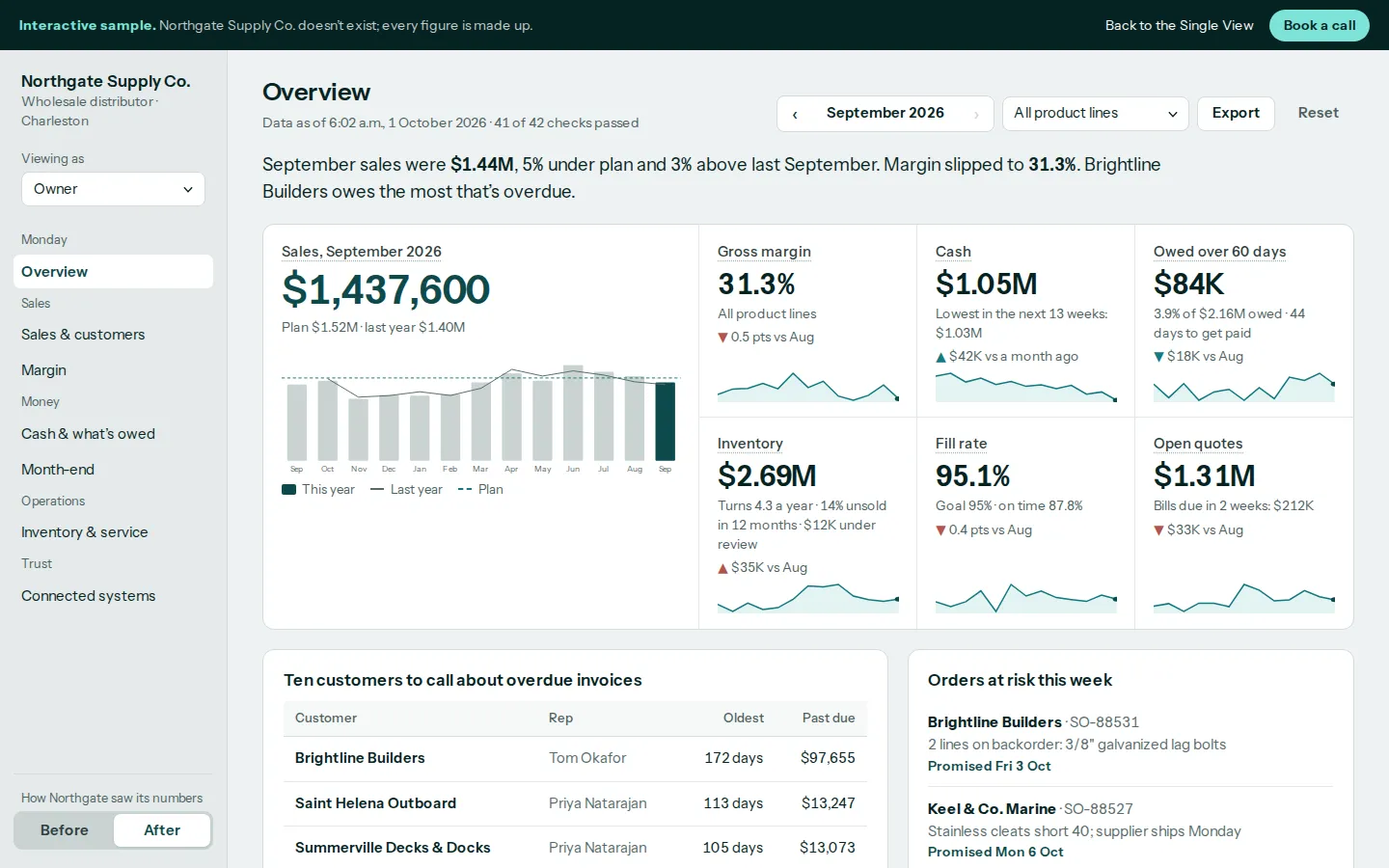
Your data, connected. One set of numbers. Dashboards your leaders actually open.
We connect the systems you already run, settle which numbers are right, and build the view your team opens every Monday.
- Accounting and ERPNetSuite, QuickBooks, Sage
- CRMHubSpot, Salesforce
- BillingInvoicing and payments
- OperationsInventory, warehouse
- MarketingGoogle Ads, Meta
- The spreadsheetsThe budget and the plan
Northgate Supply Co. · Leadership, September
Refreshed 6:00 a.m. · one data store, your cloud
Revenue against plan
$1,437,600
5% under plan · one definition, agreed
Owed over 60 days
$84,483
76 invoices · 22 customers
Quotes likely to close
$472K
From $1.31M of open quotes
Margin by customer
Orders filled complete
95.1%
Goal 95% · shipped on time 87.8%
Cost to win a customer
$1,840
Ad spend to closed deals, by channel
What you get
- Your systems connected into one data store in your own cloud
- Your key numbers defined once, agreed by finance and sales
- Dashboards built with the people who use them, every number traceable to its record
- Alerts on the numbers that should never surprise you
Start here
$5,000
The two-week Single View Sprint. Your systems mapped, your key numbers defined, and one live dashboard on your real data. Credited to the build.
Full builds from $25,000, fixed in writing before we start.
Book a systems callThe Single View has its own page.
How it works, what you get, what it costs and how the weeks run. And a full sample dashboard you can click through, down to the invoices.
Try to send it without a person.
The system drafted a quote. Three buttons, three ways round the check. Nothing here leaves the page.
Quote for 240 brackets
$3,408.00
To Keel & Co. Marine
Drafted by your quoting system · 2 minutes ago
Sent to the customer

Six weeks. Then it’s yours.
Week 1
Map
We sit with the people who do the job, measure how it runs today and agree what good looks like. If it shouldn’t be built, we say so here.
You get The job mapped, the baseline measured, a fixed plan
Weeks 2–5
Build
It runs on your real data, in your own accounts, from the second week. You see it working every Friday.
You get A working system, tested on real cases
Week 6
Hand over
Your team runs it with us beside them until they’d rather we left. Then 30 days of fixes.
You get Training, a runbook, a recorded walkthrough, the keys
What you keep
- Code and promptsWith Chris’s teamIn your repository
- Accounts and dataWith Chris’s teamIn your cloud, under your login
- Runbook and recordingsWith Chris’s teamWith your team
- Who approves whatWith Chris’s teamWritten into the system
Published prices. Fixed in writing before we start.
What moves a price: how many systems we connect, the state of the data, and how many decisions need a person.
Free
Scoping call and one-page plan
30 minutes, plan in two business days
Including the times the right answer is a setting you already own.
$5,000
Single View Sprint
Two weeks · credited to the build
Your systems mapped, the key numbers defined, one live dashboard on real data.
From $15,000
AI Workflow Pilot
Four to six weeks · fixed before we start
One job running in your accounts, your team trained to run it.
From $25,000
Single View build
Six to ten weeks · fixed before we start
Your systems connected, your numbers agreed, the dashboards your leaders open on Monday.
From $1,500 a month
Care
Monthly · cancel any month
Monitoring, fixes, model updates and a one-page note on what changed.
A good fit if your people spend hours a week keying, chasing, checking or rebuilding the same things, and you run five or more systems that don’t talk.
We’ll tell you not to build if a setting in software you own would do it, if the process changes every week, or if the volume is too low to pay back.
Now draw your own job.
Describe one job your team repeats. We’ll draw how it runs today, what a system would take over and where a person stays in charge, then draft your one-page plan.
Questions
What operators ask first.
Where does our data go?
Nowhere new. Everything runs in your own cloud and software accounts, under your logins. We work inside them with access you grant and can take away, and we keep no copies after handover.
What if the system gets something wrong?
Anything that spends money, sends something outside the company or changes a record that matters waits for a named person. Everything else is logged, so you can see what it did and why, and we test it against your real cases before it goes live.
Do we have to replace any software?
No. We build on what you already run. If something you own already does the job, we tell you, and that advice costs nothing.
Who owns it when you’re done?
You do: the code, the prompts, the accounts and the data. Your team is trained to run it, and you can keep us on a care plan or not.
What happens when the AI models change?
The system isn’t tied to one model. On a care plan we test new models against your real cases and switch only when they do better.
Who will we work with?
Chris leads every engagement, with his technical team building alongside your people.
Start here